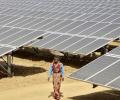
Arunabha Ghosh on why India will increasingly become an energy great power, but not an energy hegemon.

'How can Kashmir be demilitarised if the terrorist threat remains and Pakistan continues to incite elements in Kashmir to keep the internal situation unstable?' asks former foreign secretary Kanwal Sibal.

'We are witnessing a spectacle of breathtakingly creative diplomacy at work, riveted on the firm foundations of the country's strategic autonomy,' says Ambassador M K Bhadrakumar.

Excerpts from Prime Minister Narendra Modi's speech at the Combined Commanders Conference on board the INS Vikramaditya at sea, off the coast of Kochi.
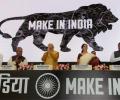
'India is going to maintain its ties to China, India is going to develop a strong relationship with the United States. It means that India is going to have the flexibility to pick and choose its friends.' 'That's traditional Indian foreign policy, and it's smart.' Former US ambassador to India Frank Wisner, one of America's sharpest minds on South Asia, tells Aziz Haniffa/Rediff.com what Washington can expect from Narendra Modi's visit.

'I believe one of the most critical issues is the common threat we face from Islamist radicals and the continuing and unimpaired financing of Al Qaeda, the 'D' Company, the Haqqani network, the LeT and the Jaish-e-Muhammed.'
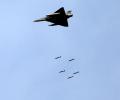
'Crucial intelligence was obtained by a R&AW operative from a couple of moles inside the camps four days before the Balakot operation.'
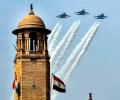
'No country can ever be free to make its choices and remain independent if it continues to wear borrowed plumes,' warn Lieutenant General Ashok Joshi (retd) and Colonel Anil A Athale (retd).

With Beijing having had a profound rethink on India's admission as a full member of the Shanghai Cooperation Organisation, the tectonic plates of the geopolitics of a massive swathe of the planet stretching from the Asia-Pacific to West Asia are dramatically shifting. That grating noise in the Central Asian steppes will be heard far and wide -- as far as North America, says Ambassador M K Bhadrakumar.

Prime Minister Narendra Modi's three-day visit to Britain has seen India and the UK agreeing on Rs 90,000 crore deals.

'This is the first time that the Americans have agreed to refer to "cross-border terrorist attacks" in a joint statement.' 'No wonder Pakistan has called the joint statement "singularly unhelpful" and has blasted it, and its all-weather friend China has applauded Pakistan's frontline role in combating terrorism,' points out former foreign secretary Ambassador Kanwal Sibal.

'It is vital we should form an international coalition against ISIS, because their brutality and the use of the Internet for jihadist activities is a reminder that the entire world community has to be in this together,' US Congressman Ed Royce, chairman of the House Foreign Affairs Committee, tells Aziz Haniffa/Rediff.com in an exclusive interview ahead of Prime Minister Modi's visit.

'There will be some issues of contention, especially on H1B visa and on trade policy.'

'It is in the interest of both sides that the visit of the US President is seen as being successful. Both sides have invested considerable political capital in it. This rapid exchange of visits and the decisions taken have to be justified, beyond the symbolism, which is no doubt important in itself. This opportunity to impart a fresh momentum to ties should not be missed,' says former foreign secretary Kanwal Sibal.

Prime Minister Narendra Modi on Tuesday said Australia will not be at the periphery of India's vision but at the centre of its thought, as he called for closer bilateral security cooperation and a comprehensive global strategy to tackle the menace of terrorism.
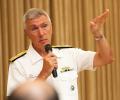
Admiral Samuel J Locklear III, Commander of the US Pacific Command, has not ruled out militants fighting in Afghanistan today switching their attention back to Kashmir post-US and NATO withdrawal of its troops from Afghanistan, and expressed concern over the recent terrorist attacks across the Line of Control that has exacerbated tensions between India and Pakistan.

The Mars mission is overwhelmingly irrelevant to space science and won't advance the frontiers of knowledge. It will divert attention from the real technological challenges facing the Indian space programme, and will further distort our science and technology priorities, says Praful Bidwai.

Prime Minister Narendra Modi, who recently completed one year in office, has, in an exclusive interview with Smita Prakash, editor, ANI, said the opposition alleging that his government is a "suit boot ki sarkar" is definitely better and more acceptable than being labelled a "suitcase" (ki sarkar), and satirically added, that after ruling for sixty years, the Congress has suddenly remembered the poor.
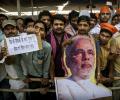
'Modi's victory is his own victory. Now what he has done thereafter, it seems to me, leads us to believe that he was a bit too prolific with his promises.' 'One achievement of Modi's I will praise is that he has put the fear of God among his ministers and officials.' 'Indira Gandhi's sentiment of controlling everything, centralising power in to her hands is the quality that persists in Modi' Veteran journalist Inder Malhotra casts his experienced gaze on one year of the Modi Sarkar.
.jpg)
Climate change and US-India collaborations in renewable energy resources will be up for discussion at the US-India energy summit coinciding with Prime Minister Narendra Modi's visit to Washington, DC, later this month, reports Aziz Haniffa.

Aziz Haniffa, who has covered every Indian Prime Minister's visit to the US since Rajiv Gandhi in 1985, gives us a peek into what's happening in Washington, DC on the eve of the Modi-Trump summit.

The leaked documents include details of submarine's underwater sensors, above-water sensors, combat management system, torpedo launch system and specifications, communications system and navigation systems.

Ashley J Tellis, a leading authority on Indo-US relations, tells Archis Mohan in an emailed interview that it is time Washington and New Delhi agreed on the contours of their 'strategic partnership', and that India's elite could learn from Prime Minister Narendra Modi in how he has put India's interests first and his own sentiments about the Americans second.
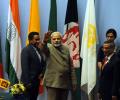
'If his three priorities are the economy, the economy, the economy, then there is need for a stable region, a stable neighbourhood.'

There are some larger policy issues related to the submarine as a platform and the modernisation programme of the navy that merit brief recall and review, says C Uday Bhaskar

President Obama had no intention of risking a global conflagration on account of the use of chemical weapons in Syria, especially at a time when he was struggling to wind up the wars his predecessor had started, says T P Sreenivasan
'We don't want confrontation; we are trying to build a cooperative relationship in which both sides have stakes in producing an improving climate of relations and responsible behaviour.' What does Shiv Shankar Menon, one of India's most brilliant diplomats and the former National Security Advisor, think of the Modi visit to the US, the Chinese stand-off in Ladakh and the situation on the LoC?
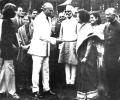
'Indira Gandhi, it appears, did not to consult her Cabinet colleagues, or diplomats, or civil servants when she decided to sign the agreement in Shimla.' 'We ruefully recall Bhutto's perfidy and the Indian prime minister's gullibility,' says Lieutenant General Ashok Joshi (retd).

President Pranab Mukherjee on Monday addressed the first joint sitting of Parliament as mandatorily required under the Constitution after the general elections. The address is the political, economic and foreign policy road map of the Narendra Modi government and covers virtually all crucial areas.
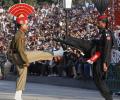
'Pakistan's capacity to carry a normal relationship with India doesn't exist.' 'The relationship with Pakistan is less important than several others.'

'Checkmating India by its nukes, Pakistan can pursue terrorism against India in the Kashmir Valley and also resume launching Mumbai 2008 style attacks.' 'The military oligarchy in Pakistan has a totally different view of what is desirable and possible in the subcontinent.'

In his penultimate State of the Union address, Barack Obama said that the economy is improving.

'We saw how vigorous democracy was when it dislodged authoritarianism under Indira Gandhi. We saw its vigour again when it voted Mr Modi out of humble origins as prime minister. It was Nehru who laid that foundation for India and what is worrying today is Modi's rather imperial style of functioning,' says writer Nayantara Sahgal.

Read the full transcript of President Obama's State of the Union address on Wednesday at the US Capitol in Washington.
 © 2026 Rediff.com - Advertise with us - Disclaimer - Privacy Policy - Sitemap - Feedback - About us - Terms of use - Grievances